Why Your Old Workout Routine May Stop Working in Perimenopause
If I had to pick one word that would encapsulate the period of time between roughly 45 and 55 — give or take a few years on either side — it would be:
Adaptability.
Chinese medicine works by helping move what is blocked, stuck or being resisted, and over and over through this stage of life the same theme comes up: adaptability and being willing to adapt.
That willingness to adapt is a key component of this transition. Exercise is one of the places where women discover this first.
Many women have a hard time admitting that they simply don’t have the mojo they once did. And even when the motivation is there, often the body is not. Something you have done for years suddenly doesn’t feel the same. Maybe you have always lifted weights four days a week. Maybe you run. Maybe you love HIIT classes or long bike rides.
The workout itself hasn’t necessarily changed. But your response to it has.
You might be more sore. Old injuries may start talking again. You don’t recover as quickly. You sleep badly after a harder workout. Or something that used to make you feel energized now leaves you feeling depleted for the rest of the day — sometimes for the next two days.
Preserving Vitality
Classical Chinese Medicine philosophy is, at its core, about the preservation of vitality. Vitality naturally wanes as we age, and yet it is what we rely on to keep us upright, functioning, and healthy through all of our life stages.
One of the clearest ways to understand this is through Yin and Yang.
Yang is vitality. Yin is what stores that vitality.
The health of one depends on the health of the other.
In the body, the Kidneys belong to Water and are considered the deepest expression of Yin. Yang is stored within Water (see image below), where that warmth can be preserved and used to support the body’s ongoing activity and transformation.
In health, you can think of Yang like sunlight descending from above and being received and stored within Water below.
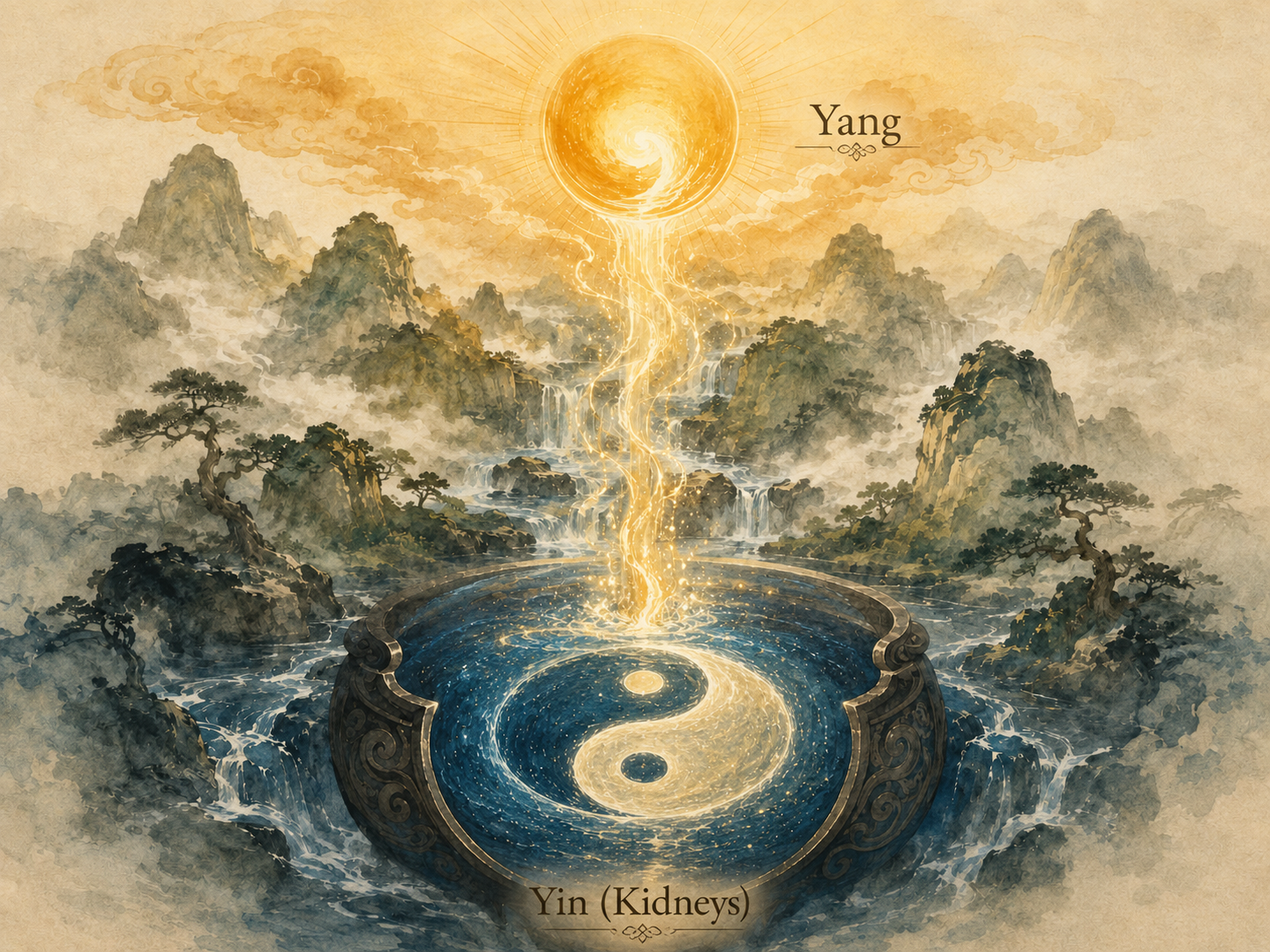
Preservation of vitality is key to aging.
As we age, Yang naturally begins to decline. We still have access to vitality, but the system may no longer have quite the same reserve or capacity to replenish itself as quickly as it once did.
One way we may notice this is through exercise.
You can still push. You can still complete the workout. But you may not have the oomph you once did, or the ability to recover as well.
Exercise Is Still Stress — Even When It Is Healthy Stress
Exercise is good for us. But it still requires something from us.
A hard workout places a demand on the body, and the body then has to recover from that demand.
If you are sleeping well, eating enough, recovering properly, and generally feeling strong, that stress may be very generative.
Perimenopause and menopause are significant transitions that can involve many changes.
If, on top of this period of change, you add poor sleep, work and life stress, family obligations, hot flashes, mood changes, etc., then a hard workout may end up depleting a system that is already exhausted.
This is often a time when shorter workouts, balanced with more recovery and restorative movement, may serve you better than continuing to push harder.
When the Workout Needs to Change: A case study
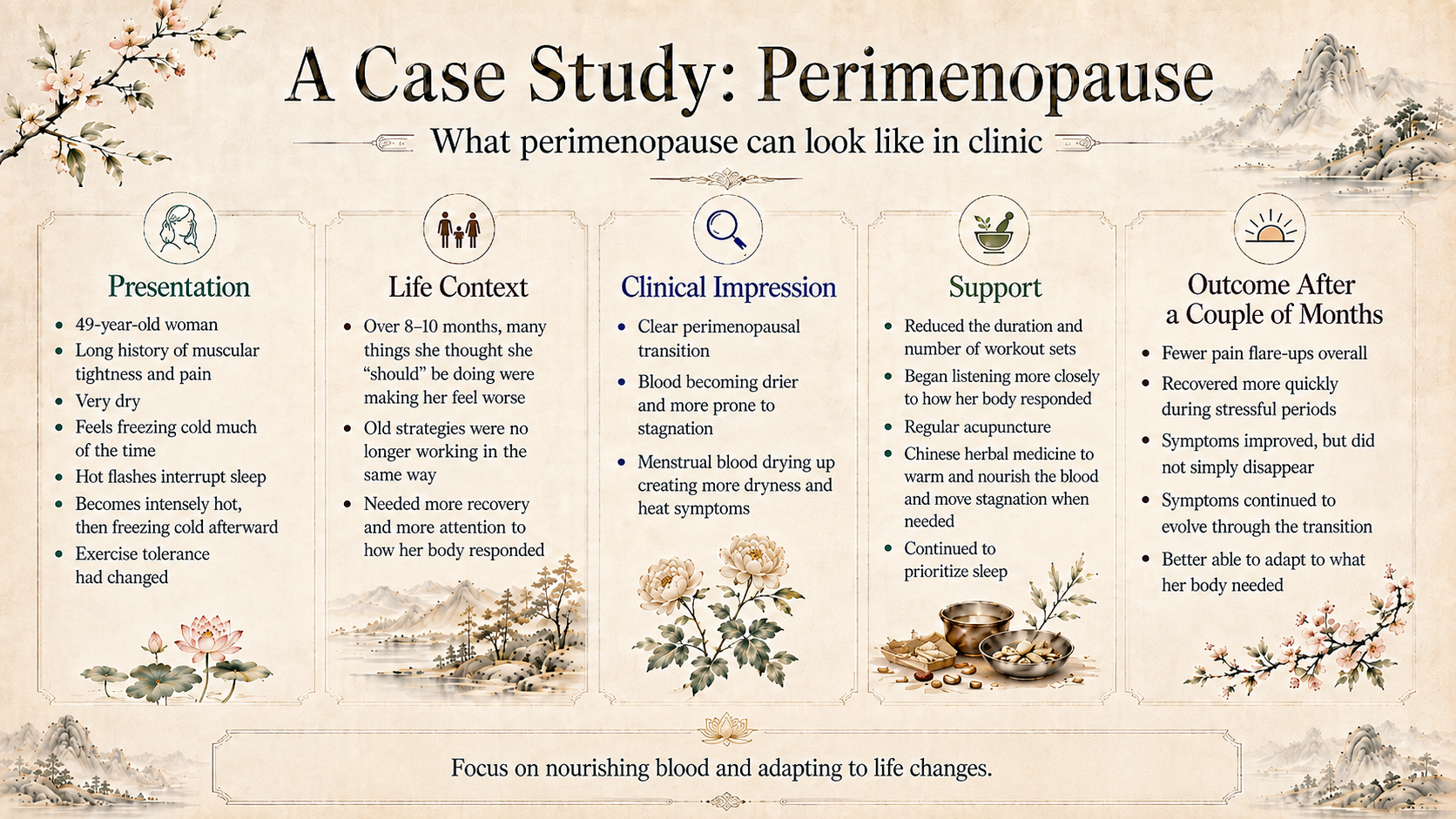
One woman I worked with was 49 and had a long history of muscular pain and old injuries.
Over about eight to ten months, she began noticing that many of the things she felt she should be doing were no longer helping. In fact, they were creating more problems.
Her pain was increasing. Old injuries were flaring. She was very dry, often freezing cold. She was also beginning to experience hot flashes that interrupted her sleep.
The answer was not to stop exercising.
She continued lifting weights and still did higher-intensity exercise.
What changed was the amount.
She reduced the duration of her workouts and the number of sets, and paid much closer attention to how her body responded afterward.
Alongside that, she came in for regular acupuncture and used Chinese herbal medicine to warm and nourish her blood and help move stagnation when needed. She continued to make sleep a priority.
After a couple of months, she was experiencing less pain, fewer flare-ups, and was recovering much more quickly after stressful periods.
That is a good example of what adaptability can look like in real life.
She did not stop being active; she simply adapted to life.
Look at What Happens After the Workout
Observing how you feel in the 36 hours post-workout can be valuable information.
How do you feel that evening?
How do you sleep?
How do you feel the next morning?
What about the following day?
If every hard workout is followed by poor sleep, significant soreness, old injuries flaring, or a day of feeling completely drained, the body is giving you information.
That doesn’t necessarily mean you need to stop doing that exercise.
It may simply mean you need to adapt and do less of it at once.
Change the Dose, Not Necessarily the Exercise
For some women, the answer may be fewer sets.
For someone else, shorter workouts.
Maybe there needs to be more space between hard sessions.
Maybe one week you feel great and can do more, and another week your sleep has been terrible and doing less makes far more sense.
There are also absolutely women who need to move more, not less. If someone is sedentary, regular daily movement may be exactly what the body needs. If someone is overexercising, reducing the intensity or duration may be more appropriate.
There is no single ideal “perimenopause workout.”
A better question is:
What amount of movement allows your body to adapt, recover, and become stronger?
Old Injuries Can Become Part of the Picture
As women age, blood gradually becomes drier and more prone to stagnation. During perimenopause, old injuries and previous weaknesses can become more noticeable as the body works to recalibrate.
Sometimes the injury itself is not new. Your shoulder has bothered you before. Your hip has always been a little tight. Your low back has had problems on and off for years. But now those areas may take longer to settle after exercise or flare more easily when the overall system is going through change.
Supporting Old Injuries and Tightness
This is also where getting some hands-on support can be really useful.
Depending on what is going on, that might include osteopathy, fascial release work, massage or acupuncture.
These approaches work differently, but all can be useful when there are areas of the body that have become tight, restricted or difficult to move through.
Acupuncture can also be used more broadly when an old injury is part of a larger picture of blood stagnation, dryness, poor recovery, or changes happening elsewhere in the system.
The goal is not necessarily to chase every old injury individually. It is to help the body move and adapt more easily as a whole.
Be Careful With All the Noise
There is a lot of information on social media right now about how women should be exercising and eating during perimenopause.
Some of that guidance can be useful when used as a permeable guideline.
Rigidly adhering to exercise and nutrition ideals — particularly when your own body is telling you something different — is not your friend during this transition.
Perimenopause is a time to come back to yourself. To trust your own sense and to turn away from the noise.
Pay attention to what actually feels nourishing. Notice what you recover well from. Notice what helps you sleep, what leaves you depleted, and what simply no longer feels right.
General guidelines can give you a place to start.
But your own response is what tells you whether something is actually working for you.
This stage of life asks us to become much more familiar with our own needs rather than continually measuring ourselves against somebody else’s.
Working With the Body You Have Now
Perimenopause is not about giving up exercise or becoming less active.
It is about recognizing that the body is adapting to a significant transition.
The goal is not to prove that you can still tolerate exactly what you did ten years ago. It is to learn how much stress your body can absorb, how well it can recover, and what it is asking for now.
Some weeks you may have more energy and capacity. Other weeks you may need more recovery.
Neither is a failure.
It is simply part of learning how to work with a body that is moving through a new stage of life.
Sometimes the most productive thing we can do is adapt.
Work With Us
If your workouts no longer feel the way they once did, or you are finding that recovery is becoming harder during perimenopause, we can help you look at the bigger picture.
At our Kelowna clinic, we use acupuncture and classical Chinese herbal medicine to support women through this transition based on how the changes are showing up in the individual body — whether that means more pain and tension, poorer recovery, sleep disruption, dryness, fatigue, or old injuries beginning to flare.
The goal is not to force your body back into an old pattern. It is to support it in adapting well to the stage of life you are in now.