Bloating, Reflux and New Food Intolerances in Perimenopause
One of the more surprising changes women mention during perimenopause is that their digestion suddenly feels different.
Foods they have eaten for years may no longer sit well.
There may be more bloating, reflux, nausea or heaviness after eating. Bowels may become slower or looser. Some women begin noticing reactions to foods they previously tolerated without any problem.
In clinic, these digestive changes are very common through the late 40s, perimenopause and menopause.
In classical Chinese medicine, the body is understood through the relationship between Yin and Yang. Yang is the warming, active and moving force of the body, while Yin provides the substance, moisture and nourishment that Yang acts upon.
Digestion relies on both. We need enough warmth and movement to transform and distribute food and fluids, but we also need enough moisture and substance for that process to occur properly.
Digestion belongs primarily to Earth — the centre of the system. Earth receives food, transforms it and distributes nourishment throughout the body.
During perimenopause, that centre can become either too damp and stagnant or too dry.
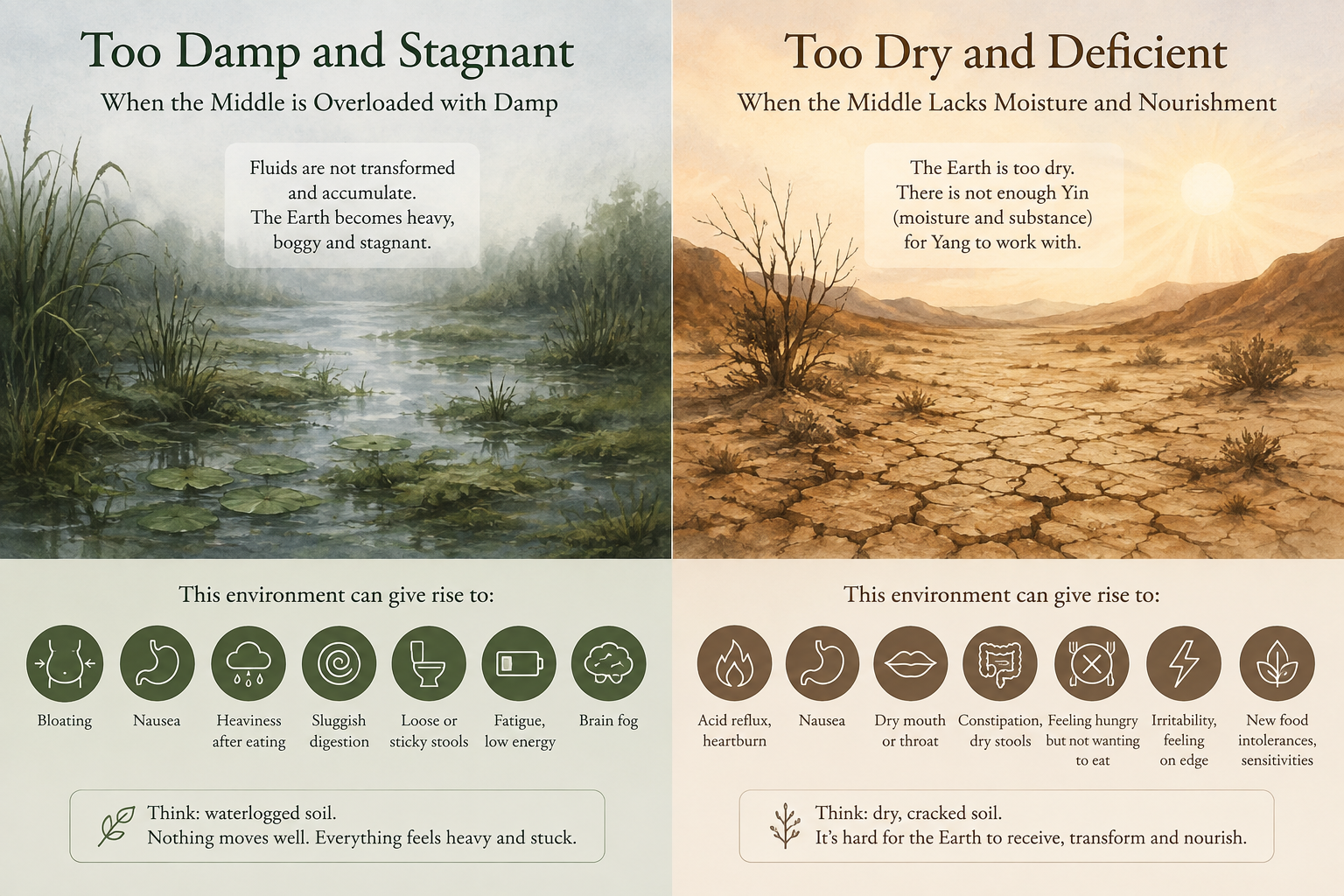
2 common ways digestive disharmony occurs during perimenopause.
The Digestive Centre Has to Keep Things Moving
Earth sits at the centre of the Five Element system.
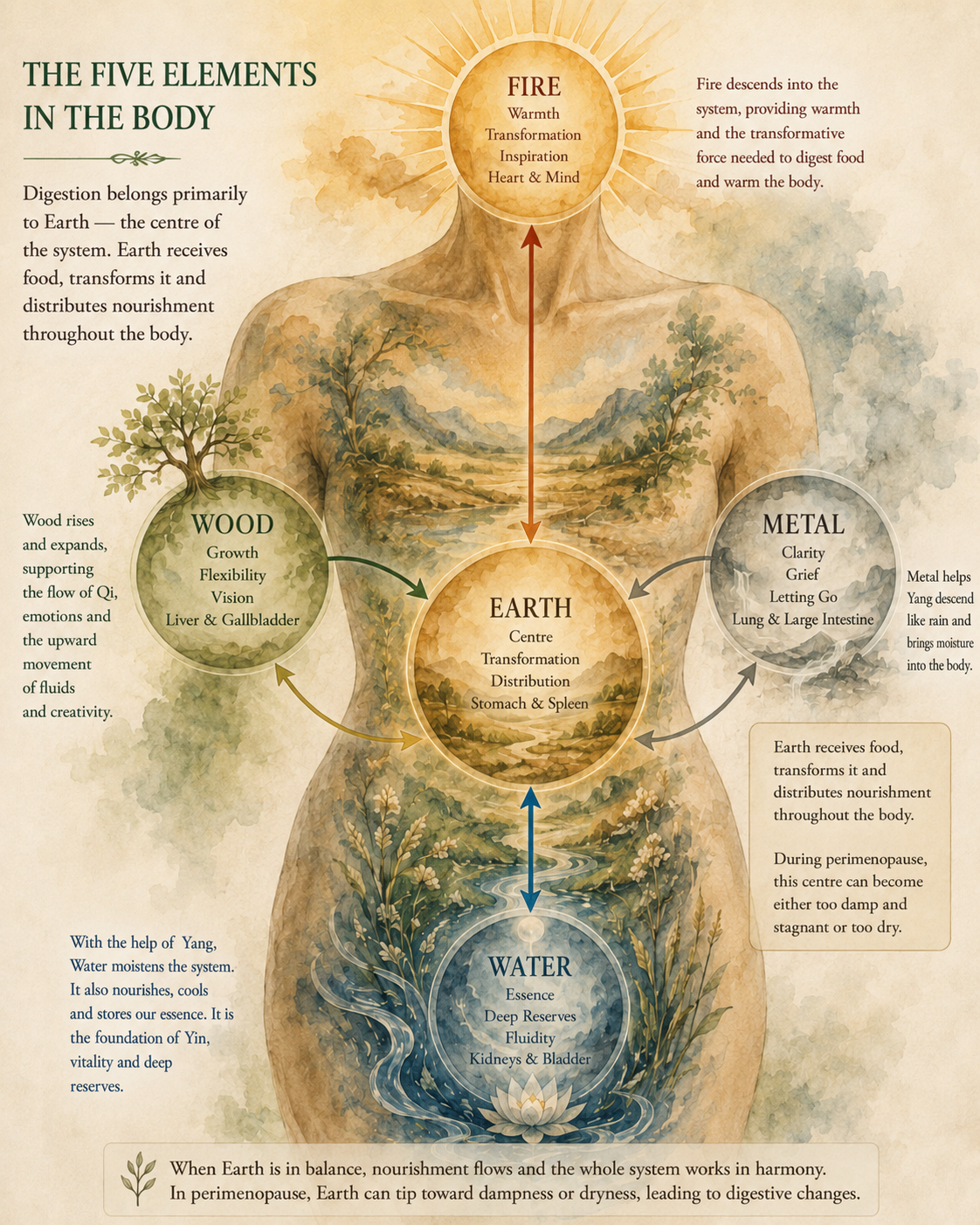
The 5 elements as they relate to organs, emotions and physiological functions.
It gathers, transforms, and distributes nourishment while helping connect the movements occurring throughout the rest of the body.
In this process, Yang and Yin work together.
Yang provides warmth, movement and transformation. Yin provides the tangible substance being transformed — including fluids and the nutritive portion of food.
Yang transforms Yin by warming it, moving fluids and helping distribute nourishment throughout the body.
As Yang naturally becomes less robust with age, that transforming function can also become weaker.
As a result, food and fluids may not be processed as efficiently and can begin to linger or become stuck.
This may show up as:
Bloating
Sluggish digestion
A heavy feeling after eating
Loose stools
Constipation
Fatigue after meals
Food sitting for a long time
Increasing sensitivity to certain foods
When the Middle Becomes Too Damp
One common presentation we see is a digestive centre that becomes too damp and stagnant.
Think of Earth as soil that depends on an essential balance between moisture and dryness. Too much moisture creates dampness, making the soil heavy, waterlogged and difficult to transform. Too little moisture and it becomes dry, hard, and unable to properly receive or transform what is given to it.
When Yang is not strong enough to properly transform Yin, fluids and the nutritive portion of food can begin to accumulate rather than being efficiently transformed and distributed.
This accumulation is what we refer to as dampness, and the centre can begin to feel heavier, more congested and stagnant.
We may see:
Bloating
A heavy or full feeling after eating
Loose or sticky stools
Fatigue after meals
Brain fog
Sluggish digestion
Nausea
Food sitting for a long time
Increased sensitivity to rich or heavy foods
In this presentation, there is not necessarily too much fluid in the body overall. The issue is that fluid is not being transformed and distributed well, so dampness collects where it should not.
When the Stomach Becomes Too Dry
The opposite can also happen.
As women move through perimenopause, dryness becomes more common, particularly as menstrual blood gradually dries up.
That dryness can also affect the digestive system.
If the Stomach becomes too dry, there may not be enough Yin — the tangible moisture and substance — available for Yang to transform.
This may look more like:
Acid reflux
Nausea
Dry mouth or throat
Constipation or drier stools
Feeling hungry but not wanting to eat
Foods suddenly feeling irritating
New food intolerances
Bloating despite dryness
The image here is the opposite side of Earth.
If soil becomes too dry, it becomes harder for it to receive, transform, and distribute what is given to it.
The digestive centre works in much the same way. It needs enough moisture for Yang to act upon, but not so much that everything becomes bogged down.
Why New Food Intolerances Can Appear
This is where women often say:
“I’ve eaten this my whole life. Why does it suddenly bother me now?”
The food itself may not necessarily have changed.
What has changed is the environment receiving it.
If Earth has become damp and stagnant, foods that are rich, heavy, or difficult to transform may create more bloating, fullness, or fatigue than they once did.
If the Stomach has become dry, foods that are very drying, irritating, or difficult to receive may suddenly create reflux, nausea, or discomfort.
And sometimes we see both at once.
A woman can have underlying dryness while still accumulating dampness because the fluids she does have are not being transformed and distributed properly.
So the picture is not always simply too wet or too dry.
It can be a problem with how Yin is being transformed and moved by Yang.
Why This Can Become More Noticeable in Perimenopause
During perimenopause, several things are happening at the same time.
Yang naturally becomes less robust as we age, which can weaken the warmth and transformation needed for digestion.
At the same time, menstrual blood gradually dries up, and the body becomes more prone to dryness.
The system is adapting.
For one woman, weaker transformation may mean more dampness, bloating and heaviness.
For another, dryness may become much more obvious, with reflux, nausea, constipation or new food sensitivities.
And for many women, there is some combination of the two.
This is why digestive symptoms that look similar on the surface can have very different underlying presentations.
What We Look at in Clinic
We don’t just ask which foods bother her. We want to understand the digestive environment itself.
We may ask:
Does the bloating happen before or after eating?
Does food feel as though it sits for a long time?
Is there reflux or nausea?
Are stools loose, sticky, dry, or difficult to pass?
Is there heaviness after eating?
Is there thirst or a general feeling of dryness?
Are warm foods easier to digest?
Have certain foods suddenly become harder to tolerate?
Are there also hot flashes, anxiety or menstrual cycle changes?
We also use pulse and abdominal findings to help determine whether the digestive centre is primarily damp, dry, stagnant, cold or simply weaker in its ability to transform.
Two women may both come in with bloating or reflux and have very different patterns underneath.
Supporting Earth During Perimenopause
Earth is responsible for transforming and distributing nourishment throughout the body, so supporting the digestive centre can become especially helpful during perimenopause.
For many women with a weaker digestive centre, warm cooked foods are easier to receive and transform than large amounts of cold or raw food.
Regular meals may also be easier on the system than long periods without eating followed by very large meals.
But there is no single perimenopause diet that is right for everyone.
A dry Stomach needs something different from a digestive centre that is damp and congested.
Rather than continually removing foods, we want to understand why the body is having more difficulty receiving them in the first place.
Acupuncture for Digestive Changes During Perimenopause in Kelowna
At our Kelowna clinic, we use acupuncture and classical Chinese herbal medicine based on how the digestive changes are presenting in the individual woman.
For one woman, treatment may focus more on improving Yang’s ability to transform fluids and move dampness.
For another, the focus may be nourishing a dry Stomach and providing more substance for Yang to work with.
For someone else, there may be a combination of dryness, stagnation, and weaker transformation.
Perimenopause is a period of adaptation, and digestion is one of the places where those changes can become very noticeable.
Understanding whether the centre has become too damp, too dry, or simply less efficient at transforming what it receives gives us a much clearer picture of why foods and digestion can suddenly feel so different.
Work with us
Online Chinese herbal consultations may be available depending on your location. Please email us to inquire. If you live in the Okanagan Valley, we look forward to seeing you in person.