Reframing The Winter Blues
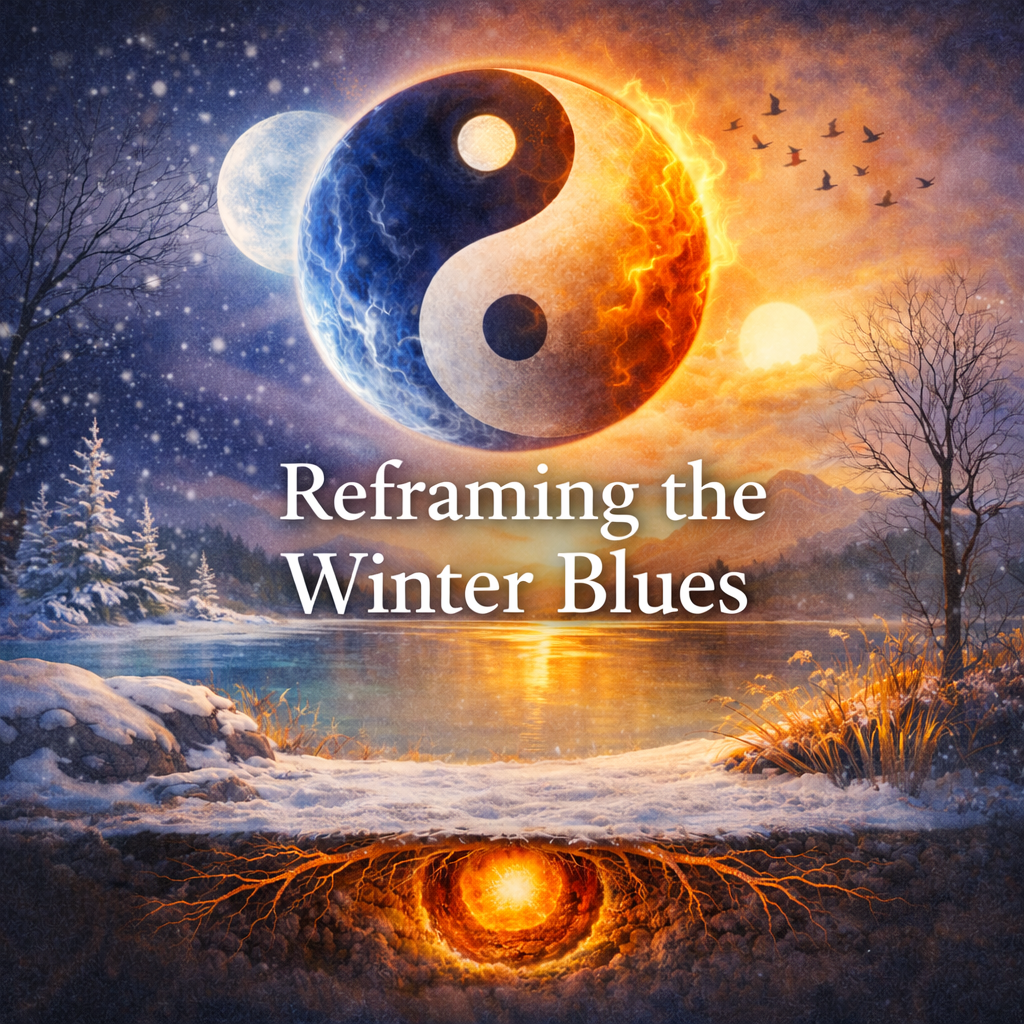
Winter deepens as yin grows and yang recedes—an inward, restorative season. Nature contracts: leaves fall, sap sinks, and visible life slows so conservation, consolidation, and repair can occur. In Chinese Medicine, yin’s cooling, nourishing, receptive qualities grow, creating stillness for yang’s warmth to gather energy for rebirth. Winter stores potential for spring. Honor it by slowing, resting, eating warming foods, drinking tea and sitting in front of the fire.
Moving Through Winter
Every January, without fail, there are 1–2 weeks where patients consistently come in feeling low; physically, energetically, and emotionally. What does this tell us? If the majority are having a collective experience, then we know that it must not just be personal.
Seasonal changes affect us all to varying degrees. As the cold rolls in, in response to the sun’s relative absence, our Yang Qi—our energy—also retreats inward. We go yinward.
Yang is warmth, vitality, and consciousness. How do you feel when your consciousness is turned inward for prolonged periods of time? What does it bring up in you?
Many people report feeling sad for no reason, lethargic, unmotivated, and even depressed. What if this is a normal response to the season and not a pathology that needs to be fixed?
What if it were your environment ushering you into the depths, opening you up to take a good look around the gritty places where you feel uncomfortable?
That feeling of wanting winter to be over is resistance to what is so. When we resist what is so, we create friction and stagnation and often blame it on something outside ourselves, i.e., winter, cold, grey skies, or snow, depending on where you live.
Physiological changes according to Chinese Medicine
Our body’s energy or Qi moves in different directions based on its associated system. For example, the Qi or Yang of the Heart, which we could easily call Fire, moves down, even though the nature of fire and heat is to rise.
Imagine it like this: light and warmth from the sun must move down toward Earth in order for life to exist. This fire is what is ultimately stored deep within as vitality. It is a resource we want to nurture, especially as we age.
The Triple Burner
Our torso is divided into three sections.
Upper Burner
Associated with the chest; Lungs and Heart.
Middle Burner
Associated with the digestive organs; Spleen (yes, it's considered a digestive organ in Chinese Medicine, which is likely a translation issue), Stomach, Liver, Gall Bladder.
Lower Burner
Associated with lower organs such as; Kidneys, Urinary Bladder, and organs of reproduction.
When we think about how fluids, gases, and heat/cold move around the body, it's helpful to keep the triple energizer in mind.
Qi moves down from above - again, think about the sun - it passes through earth, the middle burner, and is stored in the lower burner, just as thermal energy is stored in the earth's core.
Winter and the Lower Burner
Winter is associated with the lower burner. What does this mean in real life?
It means that during this time we want to support the lower burner doing what it does best; storing thermal energy.
In order to store energy, outward activity must be reduced. This isn't a punishment; it's simply life in one of its manifestations.
Living in Rhythm
The closer you can live in rhythm with seasonal changes, the healthier you will be long term. There is a saying from the Dao De Jing:
What goes against the Way meets an early end.
The Way is nature's rhythm, ebbing and flowing, coming and going, summer and winter, day and night. It might be helpful to think of winter the same way we think of sleep. As necessary and non-negotiable.
Make friends with the cold.
Make friends with darkness.
Make friends with inactivity and stillness.
It is a reciprocal relationship that can revive your spirit.
With love…