Perimenopause or Burnout? What we often see in clinic
In clinic, one of the things we see quite often in women in their late 30s and early 40s is a mix of symptoms that can look a lot like perimenopause.
Sleep changes. Anxiety. Feeling more easily overwhelmed. Digestive changes. Menstrual changes. Feeling hotter, sweating more easily, or noticing that recovery is not quite what it used to be.
Sometimes this is the beginning of the perimenopausal transition.
Sometimes it is burnout.
And often there is some overlap between the two.
The Years Leading Into Perimenopause
From a classical Chinese medicine perspective, people move through larger stages throughout life; women in seven-year cycles and men in eight-year cycles.
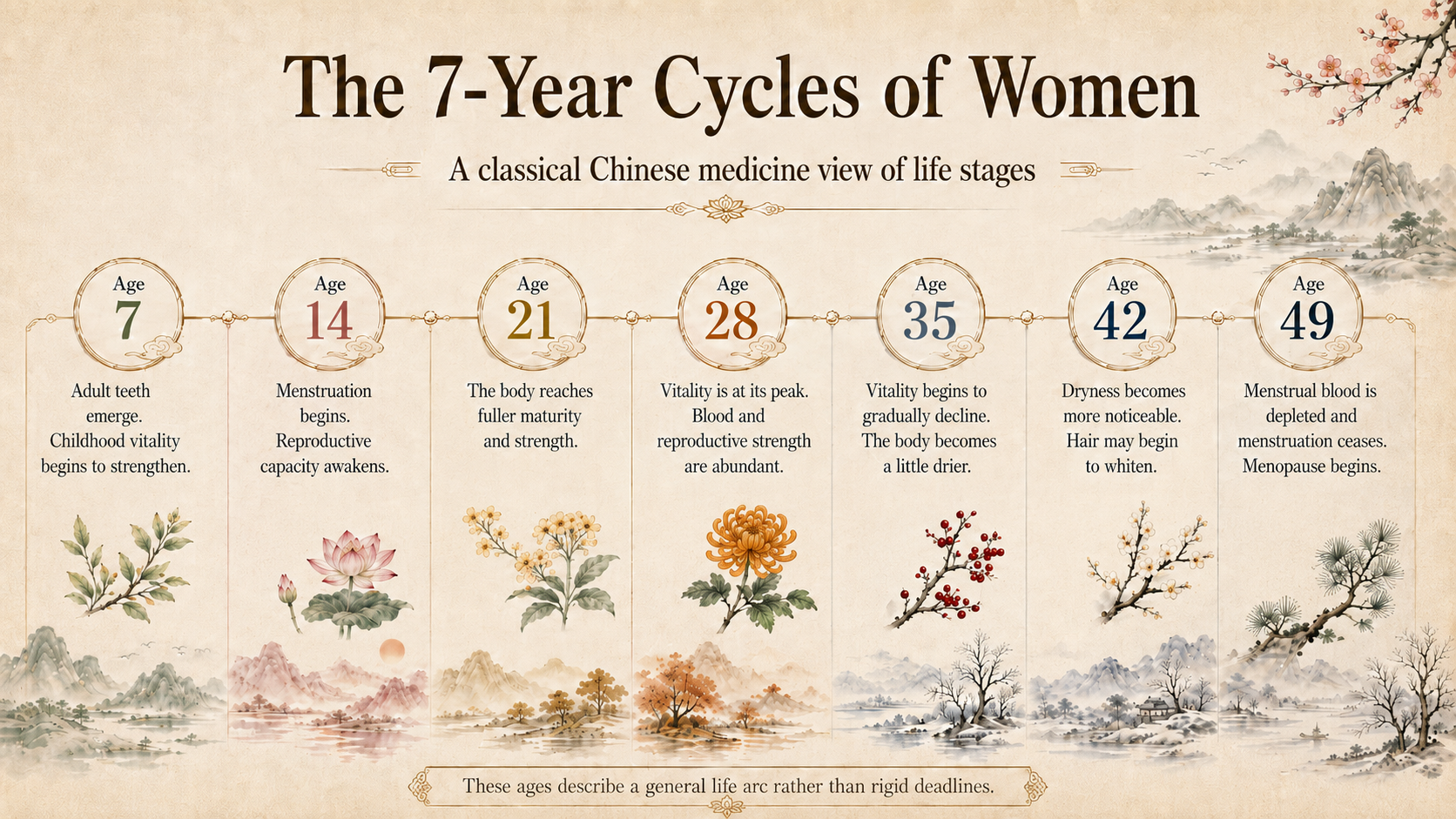
7 year cycles according to the Huang Di Nei Jing Su Wen
By the mid-30s, vitality begins to gradually decline and the body becomes a little drier. This is part of a normal life transition.
These are also often very full years.
Women may be working, raising children, caring for family, exercising, managing households, building careers or businesses, and carrying a lot of responsibility without much recovery.
In clinic, this is often where we begin to see the difference between a body that is depleted and a body that is moving more clearly into perimenopause.
What Burnout Can Look Like
Burnout does not always look like complete exhaustion.
Often women are still functioning. They are working, exercising, looking after everyone and getting everything done.
Underneath that, we may see:
Poor or restless sleep
Anxiety or feeling jittery
Feeling overwhelmed more easily
Digestive changes
Changes in bowel movements
More intense mood changes around the menstrual cycle
Feeling hot or sweating more easily
Menstrual cycles beginning to fluctuate
A feeling of constantly pushing through
A Case Study: Burnout
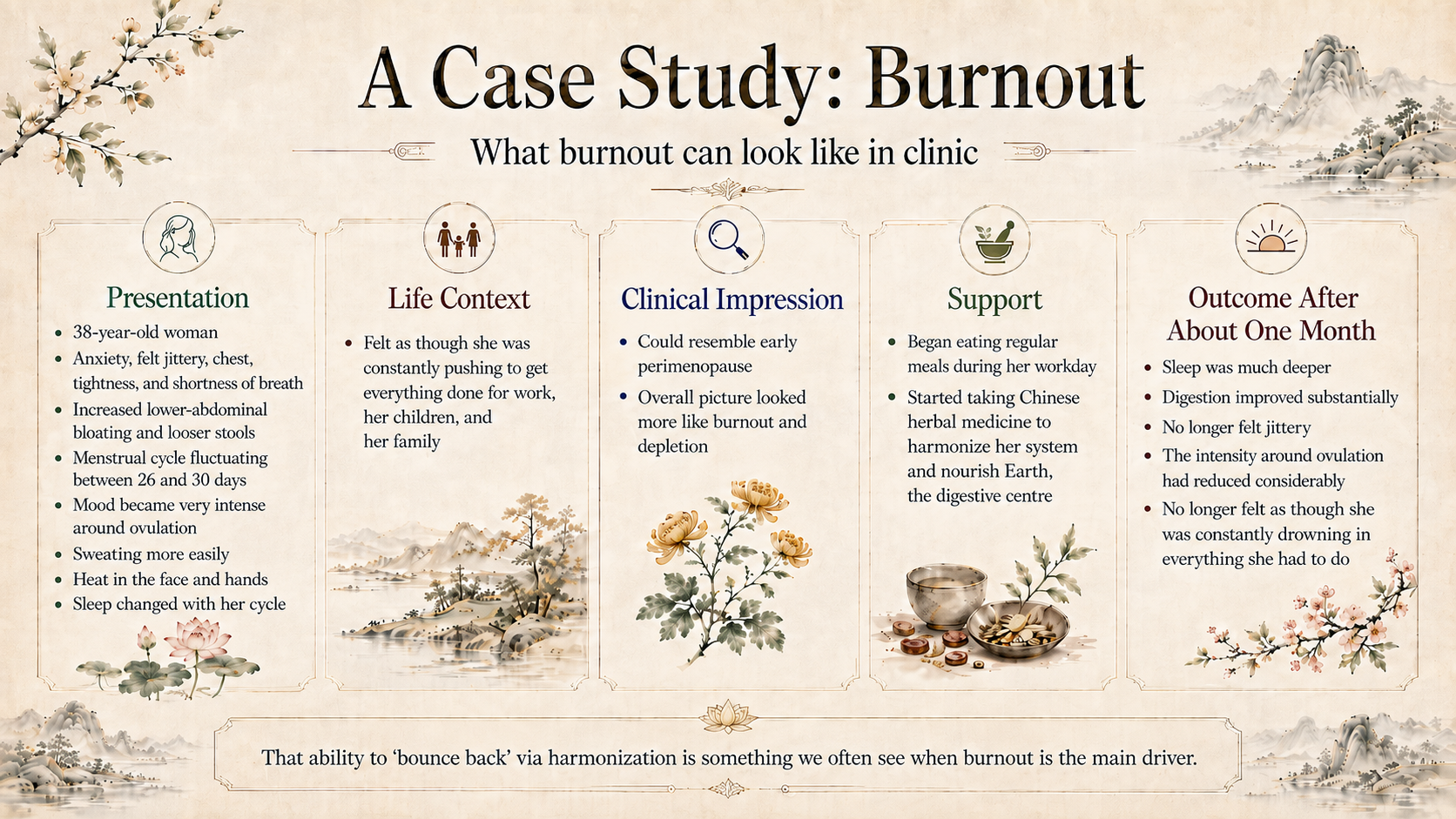
This is a typical example of a woman experiencing burnout. We see this often in clinic in women between the ages of 35-42.
A 38-year-old woman came into the clinic with anxiety, saying sshe felt jittery all the time, chest tightness, and shortness of breath. Her digestion had changed, with increased lower-abdominal bloating and looser stools.
Her menstrual cycle was fluctuating between 26 and 30 days, and her mood became very intense around ovulation. She was also sweating more easily, experiencing heat in her face and hands, and her sleep changed with her cycle.
At the same time, she felt as though she was constantly pushing to get everything done for work, her children, and her family.
Taken together, her symptoms could certainly resemble early perimenopause. Clinically, though, the overall picture looked much more like burnout and depletion.
She began eating regular meals during her workday and started taking Chinese herbal medicine to harmonize her system and nourish Earth, the digestive centre.
Within about a month, her sleep was much deeper, her digestion improved substantially, she no longer felt jittery, and the intensity around ovulation had reduced considerably.
She also no longer felt as though she was constantly drowning in everything she had to do.
That ability to “bounce back” is something we often see when burnout is the main driver.
A Case Study: Perimenopause
Now let’s look at a different presentation.
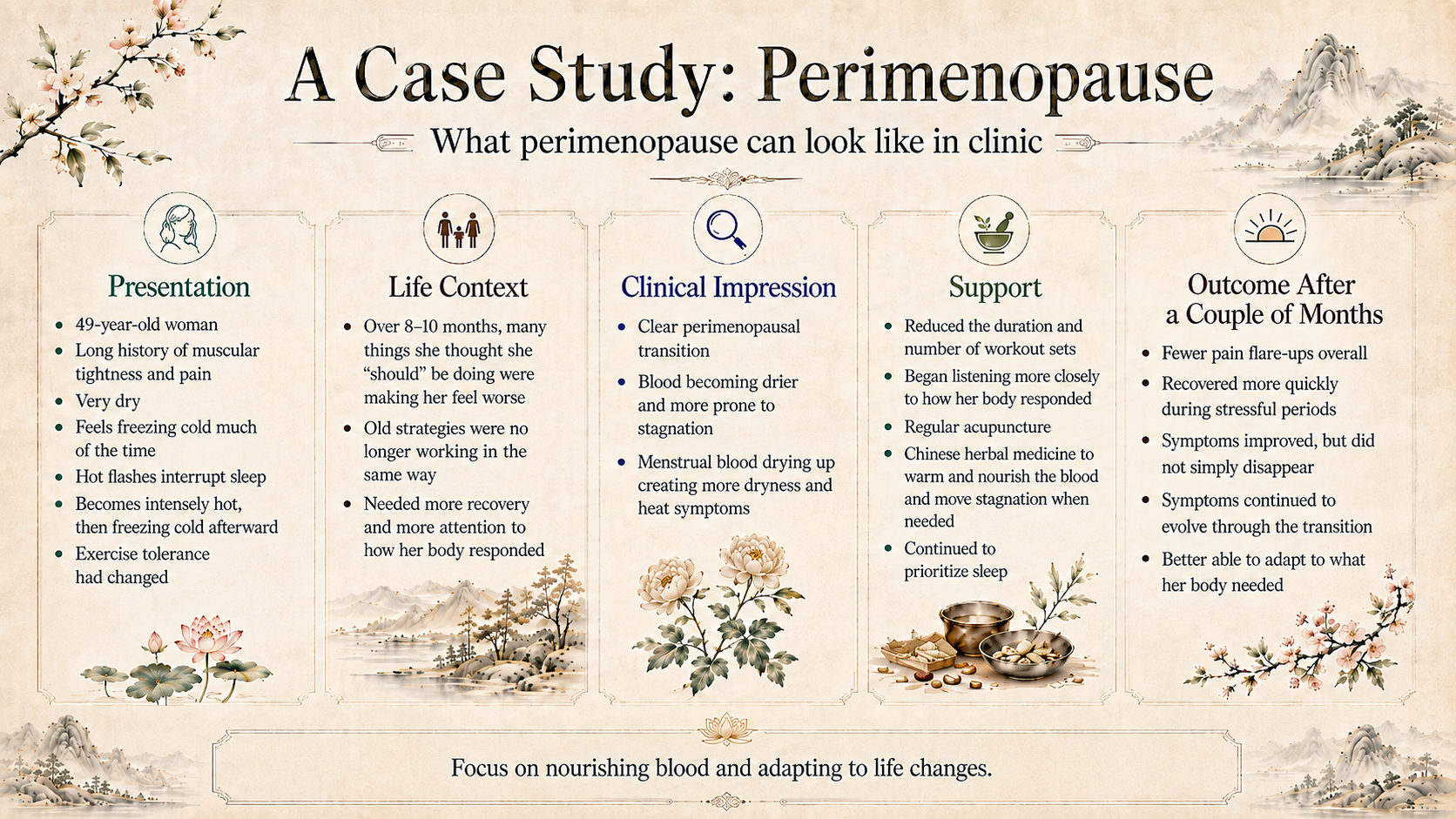
This is a typical example of a woman clearly in Perimenopause. We see this often in clinic in women between the ages of 42-52.
A 49-year-old woman came in with a long history of muscular tightness and pain. Over time, she began noticing that many of the things she thought she “should” be doing were actually making her feel worse.
She was very dry, felt freezing cold much of the time, and over time had begun experiencing hot flashes that interrupted her sleep. She would become intensely hot and then feel freezing cold afterward.
Her exercise tolerance had changed as well.
She did not need to stop lifting weights, but she did need to reduce the duration and number of sets so her body could recover more effectively.
She also used regular acupuncture, Chinese herbal medicine to warm and nourish the blood and move stagnation when needed, and continued to prioritize sleep.
Her symptoms improved overall, but some did not disapear completely. Some could and did recur but we were able to catch them quicker as we got to know her body and how it was changing.
We continue to evolve with her body as she moves through the perimenopausal transition.
Sometimes It Is Both
A woman can also enter perimenopause already depleted.
Years of chronic stress, poor sleep, under-eating, excessive exercise, emotional strain or simply doing too much can leave less reserve available when the physiology begins to shift.
In clinic, we are not necessarily trying to force someone neatly into one category or the other.
We are looking at what is happening in that particular woman and what her body needs at that stage.
Supporting Perimenopause & Burnout
At our Kelowna clinic, we use acupuncture and classical Chinese herbal medicine alongside changes in food, sleep, exercise and recovery when appropriate.
Perimenopause is a life transition. The aim is not to reverse it, but to support the body as it moves through it.
Burnout is your body telling you things need to change. The goal here is to start taking steps toward a more sustainable way of being.
We are here to help.